
Don’t take this opinion piece the wrong way. It is obviously tremendous news that we are seeing reports by clubs of full attendances for matches. The attraction of the product, heightened exponentially from a decade ago, is such that greater crowds gathering to watch their local team in Northern Ireland is entirely justifiable. However, caveats must be accounted for, and the reality is this is no bar to settle on. There is much still to be done.
Cliftonville – prior to the postponement of the fixture owing to the sad passing of Her Majesty The Queen the previous day – confirmed their home capital derby game with Glentoran was a sell-out. That the communities of north and east Belfast and beyond took full avail of their allocation was delightful to see, but it also doesn’t tell the whole story.
Solitude’s Main Stand Upper is, as they themselves put it, “since the end of the 2007/08 season, (sic) now only opened when the occasion demands.”
For the runners-up in last season’s Premiership, a club who sold season tickets at a speedy rate this off-season, while full attendance is a reflector of the positive work they’ve done there is still a sense of ‘what could still be’. They have replaced the Cage End with the single-tier McAlery Stand this millennium but there is licence around the ground to upgrade further. It would also surely reflect a more professional look if, in coming times ahead, the upper storey of the stadium’s imposing two-tier stand that greets you as you walk in can be opened up on a more consistent basis.
Cliftonville are right at the heart of their community. Combine that with on-pitch success, a pretty style of play under Paddy McLaughlin and European escapades like their adventure in Slovakia this summer, and you can see why increased hyperlocal interest in their progress is taken.
Their tale is far from an isolated one. Across the board, the amount of people spending their afternoons and nights out with their local is rising – and the sheer amount of historic and traditional long-standing trophy competitions like the Irish Cup, County Antrim Shield and Steel and Sons Cup additionally fill mid-week schedules.
The success of a Sunday League Cup final last campaign – where the Reds were victorious over Coleraine in a seven-goal thriller after extra time at Windsor Park – means league matches on the last day of the week are set to be more prevalent than ever this term.
The spread of the calendar between Friday and Sunday at both the top and second-tiers in particular is indicative of people still being willing to commit to watching their side away from the usual Saturday slate.
Linfield had a taster of successive Sunday clashes against Portadown, Newry City and Carrick Rangers to fit with their European journey. It is a shift seen as essential where other sports are doing the same, and the early signs are that this spread will be a hit.
Hence the salient point enters the fray. If you are going to encourage greater attendances, the venues must be fit to accommodate them.
Take the following other case studies. There was the proposed and long-planned re-development of the Glens’ Oval, for which £10m was meant to be set aside that later manifested into plans to move away entirely. Look also at aspired stadium builds for Ards and Institute, who are ground-sharing with Bangor and Derry City respectively due in Ards’ case to not having had a proper home venue for the best part of two decades and in Stute’s because of extensive flooding damage that forced them to re-locate five years ago.
A new stand to replace the dilapidated ‘Cowshed’ at Bangor’s Clandeboye Park, for which planning permission has been submitted. Portadown’s plans to upgrade their Shamrock Park home stage which have been made public by the club.
It is undeniable that there must be a real investment made in upgrading stadia and facilities.
The Sub-Regional Stadia Programme is a governmental funding plan, with £36.2m in line to be distributed and help in these types of projects.
As yet, despite that amount being determined over 10 years ago, the money is yet to be released. It is fair to say there is no time like the present, where Northern Irish domestic football is in a golden age as clubs from across the water scan an ever-greener landscape of local talent and are willing to pay a greater premium to sign them.
Larne’s Inver Park is an example of how much re-development of a venue can enliven a community and engage people in the project. But all the same, not every club has a figure with the financial resources of someone like their owner Kenny Bruce to help make this happen. Since the Purplebricks co-founder took over, the Inver Reds have transitioned to a successful full-time model and displayed their merits on a European stage in two successive years.
The growing popularity of the artificial surface, such as at the likes of Crusaders, Cliftonville, Larne and Coleraine in the Premiership, is an innovation that has paid off for some teams in the past 15 years or so. The resistance to bad weather – common on these shores – and ability for slick ball-playing football to be plied has helped the game.
It is a natural next step that focus should be placed more on upgrading stands and facilities.
The Northern Ireland Communities Minister, Sinn Féin’s Deirdre Hargey, told in July in response to a question posed by Independent Unionist Claire Sugden that while she had sought legalities and support to progress the fund, the money could not be released without Executive approval. Currently, an Executive has not yet been formed since the last Assembly election took place in May of this year.
“In order to support grassroots football and the next generation of footballers, we have to show commitment and provide investment,” said Ms Sugden. You’d be hard-pressed to find a football club board member anywhere here who disagrees with that sentiment.
There is a clear domino effect that comes with improved facilities. Increased attendances, a tightening of community links and, as clubs at the top end of the pyramid have highlighted in recent transfer windows, an ever-more appealing climate for players from across the water to join the Irish League rather than leave. Not mentioning existing players staying put.
Take one transfer case study. Conor McMenamin, a fully-fledged international footballer for Northern Ireland. The Downpatrick winger became the first active Glentoran player in almost two full decades to be capped by the national team a few months ago in the Nations League.
He was a star of a pretty dismal round of fixtures, his tricks and technique well-documented to regular Premiership viewers translating onto the international stage.
You’d expect cross-water clubs to have their eyes cast. But the Glens kept him. They kept him. And that they kept him despite rumours of Ipswich Town being prepared to pay a six-figure fee is as much a win for the Irish League as it obviously is for the east Belfast outfit.
We talk a lot about moves of players from here across the sea to England or Scotland, and there is logic behind it. Transfer fees are rising – consider that Coleraine could eventually pocket half a million after Patrick Kelly’s sale to West Ham this off-season per reports – and the talent is rising in quality quicker and quicker. That growth must be matched.
Even if by a mean of another year, if clubs can keep their prospects, how sweet that would be. It could add an extra zero to the fee when the time does come to entertain interest too.
And on the topic of Northern Ireland, remember how bouncing Windsor Park was under the peak Michael O’Neill years? Remember when sell-out crowds flocked to south Belfast to make their voices heard? Did that not all coincide with the stadium’s refurbishment to make it a more appealing and attractive venue?
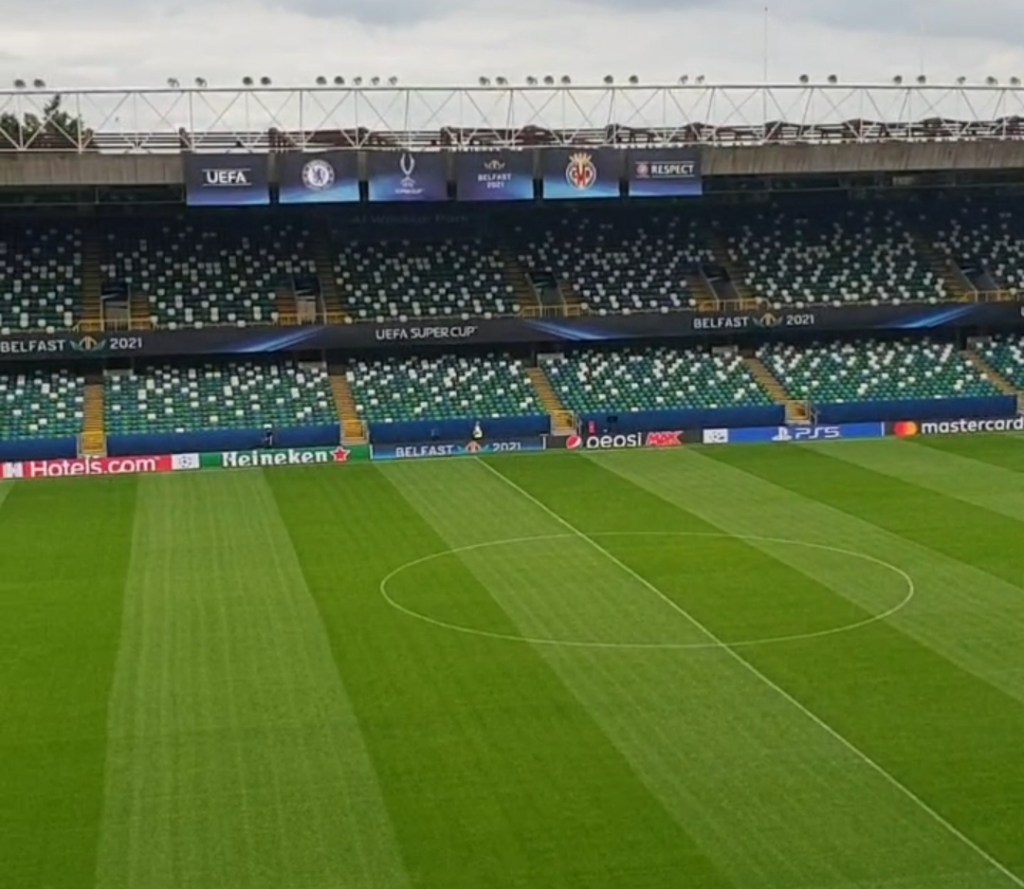
Would one also not argue that Windsor’s new look also contributed to it hosting the 2021 UEFA Super Cup, where Belfast performed one of the most successful stagings of an internationally-revered competition in recent times?
Stadia and facilities are a common denominator. There is no catch-22. There is no lose-lose.
Attendances. Atmosphere. Transfer appeal. Community engagement. Talent production and retention. All would surely be the effect of a cause, a cause of refining and upgrading our venues. A cause that can in turn broaden football’s capabilities on and off the pitch. It’s what supporters want, it’s what everyone wants.
It would assuredly assist NIFL chief Gerard Lawlor’s spoken aspiration for 80% of top-flight clubs to be full-time in the next half-decade as well. Cliftonville, who this article started with, are not a full-time club but boss McLaughlin has explained that they would like to be before too long – especially after coming within a whisker of toppling full-time Linfield in the title race a few short months ago.
Northern Irish domestic football is hot. Now is the time to action and take it to new heights.
- It’s unfair to put blame at feet of Linfield and Cliftonville for Irish Cup Final crowd disorder
 A penny for the thoughts of Linfield and Cliftonville this week. This year’s Irish Cup Final was a spectacular in every sense. Nearly 15,000 packed inside Windsor Park for the biggest-attended domestic fixture in Northern Ireland this century and an occasion to savour that, for the most part, featured backing from both sides that supported… Read more: It’s unfair to put blame at feet of Linfield and Cliftonville for Irish Cup Final crowd disorder
 - Irish League chiefs must improve provisions in place to attract younger fans and families
 Let’s get a basic fact of life out of the way first – no one likes a price hike. No one likes a price hike in the same way that no one likes paying taxes, bills, debts, insurance and other such necessary expenses which, in themselves, are rising amid a general rise in the cost… Read more: Irish League chiefs must improve provisions in place to attract younger fans and families
 - How the Irish FA’s new ‘Conference Layer’ for intermediate football can be big hit or own goal
 Changes to the intermediate football sphere in Northern Ireland have long been touted and, going by the Irish FA’s latest update on the topic, closer than ever to coming to fruition. From the 2026-27 campaign, a new ‘Conference Layer’ will be in effect as part of a radical shake-up of the intermediate levels of the… Read more: How the Irish FA’s new ‘Conference Layer’ for intermediate football can be big hit or own goal
 - Steven McCullough’s crucial goal in relegation play-off seals him as a Ballymena United great
 There’s been a change in priorities for Ballymena United during recent years – albeit not necessarily the type supporters would’ve perhaps wanted. In 2019, the Braidmen were the second best team in the Irish League. Runners-up behind Linfield that year, and just seven points adrift of top spot, the peak years of David Jeffrey’s tenure… Read more: Steven McCullough’s crucial goal in relegation play-off seals him as a Ballymena United great
 - Ending Cliftonville’s Irish Cup drought proves Jim can fix it… now he must target league glory
 Finally, it’s Cliftonville’s year in the Irish Cup. An agonising waiting game ends at last and a drought that lasted 45 painful years is over in one burst of champagne rain. Since 1979, the Reds have contrived to fail in various ways in their pursuit of that elusive ninth Irish Cup – until a man… Read more: Ending Cliftonville’s Irish Cup drought proves Jim can fix it… now he must target league glory
 Football Chatters
Leave a comment