
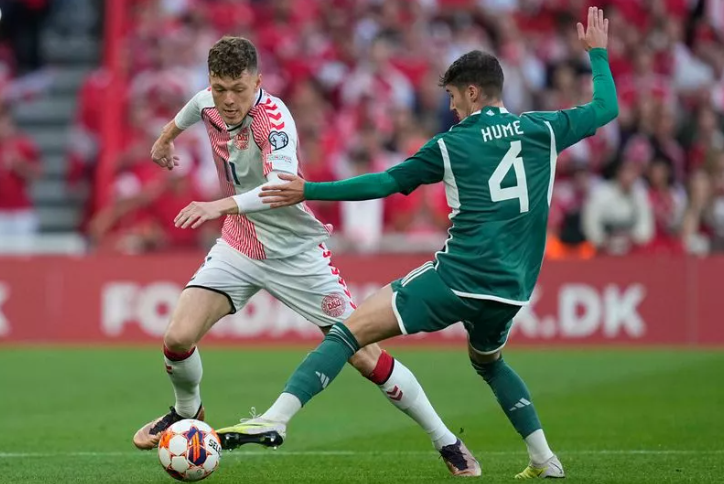
Northern Ireland’s hopes of Euro 2024 Finals qualification died a quick death.
Regrettable as that sounds, it is a cold, hard truth.
After eight matchdays, the flame of hope has been extinguished and replaced by acceptance that a summer trip to Germany next year is off the table.
With Michael O’Neill and his players garnering just six points – victories home and away against San Marino coupled with defeats by all above them – the death knell, realistically, was sounded after the 1-0 reversal to Kazakhstan in Astana last month, and since then, it has just been about ending on a high.
But as yet, there has been little to excite during the home stretch.
Frustratingly, a fifth 1-0 loss of the group was consigned upon O’Neill’s charges at Windsor Park on Tuesday night, when Adam Cerin’s sweet free-kick just five minutes into the match swept in off the post. It proved enough for group leaders Slovenia to pick up maximum points.
That at least followed an aversion of national embarrassment against the group’s expected basement dwellers San Marino three days prior, when a professional 3-0 success was achieved to leave NI in with a chance of grabbing fourth-place – the best they can do.
That chance remains, but it it is on the thinnest of tightropes.
When Group H was ratified, as Denmark and Finland completed the set alongside the Kazakhs, Slovenians and Sammarinese, supporters had their hopes up with luck perceived to be shining on the squad.
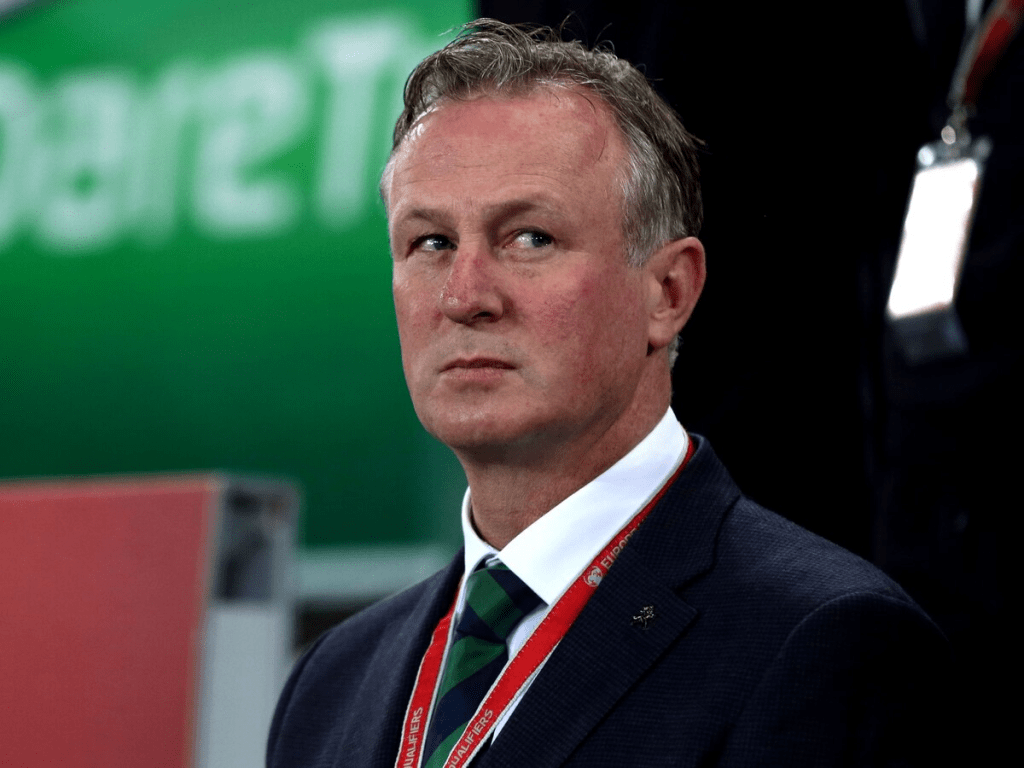
But luck has not been with the GAWA in this crusade. Nor, really, has the clinical edge or the consistent chance creation to win games.
It is up to O’Neill and the Irish FA to pick up the pieces and chart a course back on the right track after a dismal group stage. Indeed, the most memorable moment may well have been when record goalscorer and Linfield boss David Healy launched a furious broadside at the latter, pointing out a lack of progress since Euro 2016.
“The story of the group is we are just not good enough at the minute,” Healy rued following the reversal in Kazakhstan, when Maksim Samorodov’s strike twisted the knife one last time, in his capacity as a pundit on Viaplay.
“You can brush it up and talk about the good players we have had and the history and everything else.
“We just don’t have the level of players to compete. Kazakhstan are 104th in the world. If we are not scoring against them over two games, and losing both games, then you have to break it down to find a reason why.
“Michael is back in the hotseat now, and rightly so. But the structural failings over the last number of years by the people at the IFA, having not built a training ground they promised the players and fans, having not invested in the youth system and the players.
“I feel for someone like (O’Neill’s predecessor as NI boss) Ian Baraclough, who was a sitting duck previously. And what we don’t want is to be sitting here in three or four years’ time having not given Michael the tools to go and qualify for a major tournament.”
This piece will stop short of a similar offensive. But Healy’s words equally pointed out the potential for a bright future.

You need only look closer to home.
Let’s assess the top performers from the clashes against San Marino and Slovenia, starting with the former.
Paul Smyth. Excelled as a teenager at Linfield, won four trophies at Windsor Park and, after igniting with Leyton Orient in League Two last term, earned a welcome return to Queen’s Park Rangers a couple of divisions up and a well-deserved recall to the Northern Ireland fold.
Conor McMenamin. A player who also made the grade at the Blues, later showed promise at Warrenpoint Town, sealed a big move to Cliftonville, took it up a notch more with Glentoran before finally, at 27, fulfilling a long-held dream and moving across the water to St Mirren this summer, where he has kept in the groove.
And what about Slovenia?
Trai Hume. Named the Northern Ireland Man of the Match. Endearingly teak-tough as ever, he thrust onto the scene at Linfield and captained the Swifts to Steel and Sons Cup glory, broke new ground at home town club Ballymena United, returned to the Blues with his fire lit and, after an impressive first half of the campaign, moved to Sunderland where he is a first-team mainstay.
Eoin Toal. His senior international debut, in turn becoming the first Armagh native to play for NI in over a century having graduated from Armagh City’s set-up, fitting like a glove at Derry City before Bolton Wanderers came calling – he, like Hume, reached the promotion play-offs, this time in League One, and he, too, has not looked back.
Brad Lyons. Like Toal, a Northern Ireland first-team debutant. Like Toal, a player who honed much of his craft in the north west. And, while his pathway may not have been as linear, he has never for a second neglected his Coleraine past as he puts his quality on full display in Kilmarnock’s midfield.
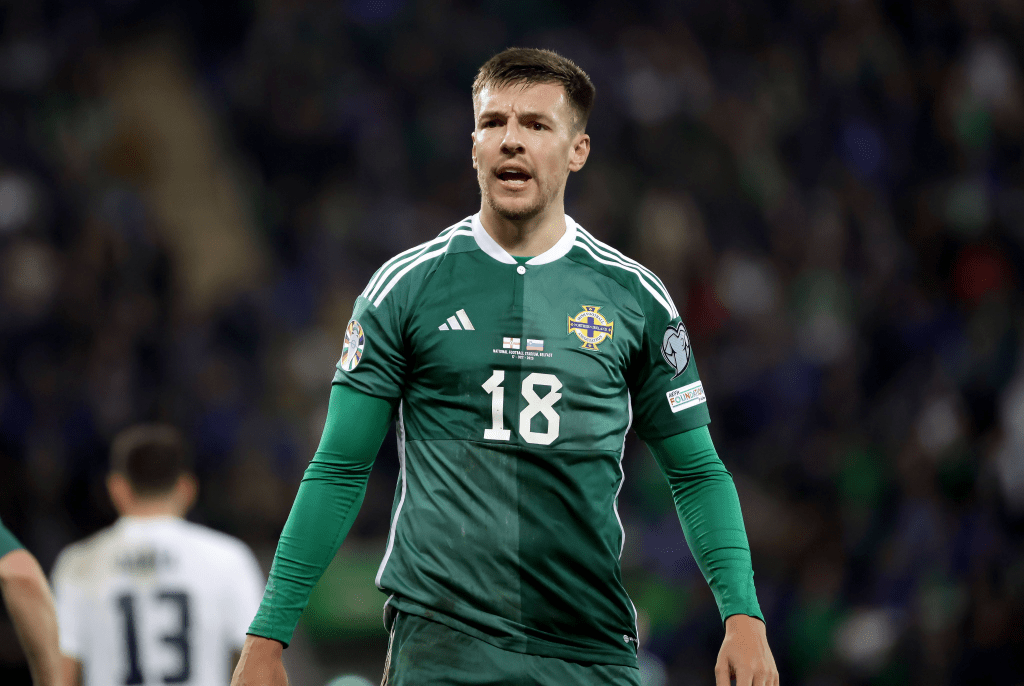
Bearing in mind that other young guns and graduates of Irish League systems like Dale Taylor (Linfield), Callum Marshall (Linfield), Brodie Spencer (Cliftonville) and Michael Forbes (Dungannon Swifts) have risen up to the plate having cut their cloth in the Irish League, this route is not one that can be neglected.
If Northern Ireland aims to move forward, the home market can provide some answers.
The Irish League is evolving, and full-time football is an option that young players can avail of increasingly locally.
Not just at first-team level, either; developed academy set-ups and scholarships are on offer to the stars of the future, with Larne, Linfield, Crusaders and Glentoran all having full-time models and methods to grow gifted youngsters in place right now.
Reducing the dependence on the eligibility pathway is worthwhile. The Under-21s featured locally bred talent like Micheál Glynn, Patrick Kelly, Sean Stewart, Terry Devlin, Charlie Allen and Ross McCausland – all players who either learned their craft in the set-ups of Irish League clubs or who are playing in it now – and with nothing to lose, why not throw a few into the senior panel?
“At 16, I didn’t go across the water the way some of the other players did,” said Hume in his post-match reaction after the Slovenia game. “I had to work my trade in the Irish League to get across.
“There’s a lot of players out there who started tonight and obviously come on that have played in the Irish League. It only shows good things that the Irish League’s producing good players.”
Telling or what?
There’d be no harm in it. With Finland away and Denmark at home to round off this latest crusade, and the next generation in need of integration, they can be allowed to test their mettle against top opposition.
This isn’t to say that the eligibility route should be cut off – those like Dan Ballard, Isaac Price, Dion Charles and Ali McCann are testament to its merits – but a fine blend of the two would seem ideal.
The domestic scene, quality-wise, has closed the gap. It is now about bringing them in – and the clubs are already doing the groundwork.
So, who will be the next Irish League star to break into the Northern Ireland senior squad?
Well, given hotshot Ben Wilson’s exceptional form in front of goal for Cliftonville that coincides with NI’s struggles to put the cherry on top of the cake, the 21-year-old may be in with a shout.

A graduate of Coleraine’s set-up before spending five years within the Brighton and Hove Albion academy, Wilson’s 12 goals in 12 Premiership appearances ensure he has hit the ground running at Solitude.
His vast array of finishing touches have already been laid bare given he is capable of finding the net with his left and right feet as well as with his head, from short range or long distance, be it arrowed or curled… he might just be in the back of O’Neill’s mind given the way he has acclimatised to Jim Magilton’s methods.
You get the sense he’s the type of player who would relish a crack at the international whip. But he’s not the only one.
The Irish League would be well worth trusting to produce quality goods, both in the present and the future.
Featured image from Chronicle Live.
- It’s unfair to put blame at feet of Linfield and Cliftonville for Irish Cup Final crowd disorder
 A penny for the thoughts of Linfield and Cliftonville this week. This year’s Irish Cup Final was a spectacular in every sense. Nearly 15,000 packed inside Windsor Park for the biggest-attended domestic fixture in Northern Ireland this century and an occasion to savour that, for the most part, featured backing from both sides that supported… Read more: It’s unfair to put blame at feet of Linfield and Cliftonville for Irish Cup Final crowd disorder
 - Irish League chiefs must improve provisions in place to attract younger fans and families
 Let’s get a basic fact of life out of the way first – no one likes a price hike. No one likes a price hike in the same way that no one likes paying taxes, bills, debts, insurance and other such necessary expenses which, in themselves, are rising amid a general rise in the cost… Read more: Irish League chiefs must improve provisions in place to attract younger fans and families
 - How the Irish FA’s new ‘Conference Layer’ for intermediate football can be big hit or own goal
 Changes to the intermediate football sphere in Northern Ireland have long been touted and, going by the Irish FA’s latest update on the topic, closer than ever to coming to fruition. From the 2026-27 campaign, a new ‘Conference Layer’ will be in effect as part of a radical shake-up of the intermediate levels of the… Read more: How the Irish FA’s new ‘Conference Layer’ for intermediate football can be big hit or own goal
 - Steven McCullough’s crucial goal in relegation play-off seals him as a Ballymena United great
 There’s been a change in priorities for Ballymena United during recent years – albeit not necessarily the type supporters would’ve perhaps wanted. In 2019, the Braidmen were the second best team in the Irish League. Runners-up behind Linfield that year, and just seven points adrift of top spot, the peak years of David Jeffrey’s tenure… Read more: Steven McCullough’s crucial goal in relegation play-off seals him as a Ballymena United great
 - Ending Cliftonville’s Irish Cup drought proves Jim can fix it… now he must target league glory
 Finally, it’s Cliftonville’s year in the Irish Cup. An agonising waiting game ends at last and a drought that lasted 45 painful years is over in one burst of champagne rain. Since 1979, the Reds have contrived to fail in various ways in their pursuit of that elusive ninth Irish Cup – until a man… Read more: Ending Cliftonville’s Irish Cup drought proves Jim can fix it… now he must target league glory
 Football Chatters
Leave a comment