
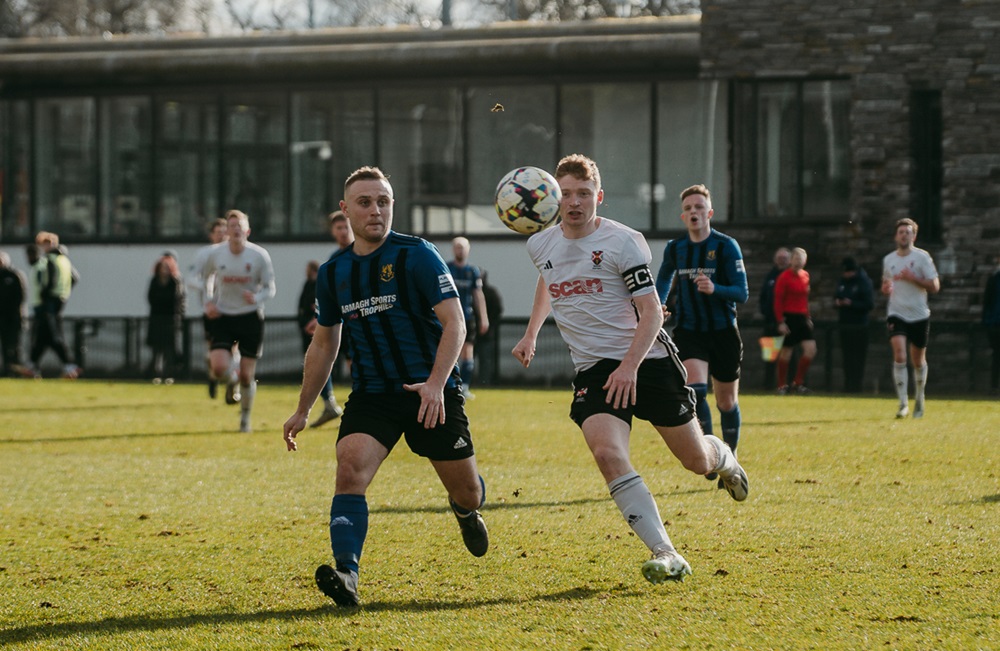
There’s been much change in the Playr-Fit Premier Intermediate League however you see it.
What was a 12-team league, in alignment with the Premiership and Championship at least in respect of its size, is now a restructured 14-team division as of the summer of 2023.
As we all know, administration was the domineering talking point 12 months ago. The licensing process generated more of a story than it normally otherwise would when it was confirmed that the Championship’s second-placed side Warrenpoint Town had not been granted a Championship or a Promotion Licence, denying them the right to contest the play-off for a top-flight place and instead culminating in their relegation to the PIL for the 2023/24 term.
It was a big story that, coupled with the conundrum over PSNI’s drop-out after they showed unwillingness to drop into the Ballymena and Provincial League, led to big changes that have left a lasting impact.
The police institution ultimately retained their Irish League status, therefore there was no relegation into the regional ranks, and respective Amateur and Ballymena League champions Rathfriland and Coagh United were promoted through a three-way play-off that increased the third-tier’s size by two.
The division’s structure was reinvented, too, removing the split and lowering the number of games played from 27 to 26 – every team plays each other once, home and away, and there is no third outing that follows.
It’s not put pains to the suspense at the top of the league. As we stand, there are three sides sat at the summit separated by a single point – Limavady United (40) leading Rathfriland and Armagh City (both 39) in that sense – while Queen’s University and last term’s promotion play-off reps Ballymacash Rangers (both 34), the former playing catch-up with games in hand on those above, can’t be ruled out of the race either.
That’s where a split truly adds to the thrills and spills; feelings of jeopardy and anguish that losing ground allows the immediate other to gain at your expense.
It’s that tension that makes every close hunt in the Irish League, in this case for promotion, feel truly make or break and, indeed, adds the satisfaction that if you come out on top, you have done it the hard way.
In an age when the future of the Premier Intermediate has been cast into doubt in certain quarters, with the Irish FA having laid down blueprints for a reform of intermediate-status football in the coming years, abolishing the split that puts it out of sync with those in the two divisions above doesn’t alleviate the strain.
There is a feeling of ‘little brother’ syndrome some associate with the third-tier these days – perhaps an unfair tag as it’s an unpredictable league where nothing’s ever close for comfort and, after all, it is the gateway to senior-status football – and if its future is to be preserved, increased parity with the top two flights would enhance the sense of belonging within the recognised NI Football League organisation.
Now, intermediate cup competitions are a factor, and with that, there is less consistency behind when league games are played in a season. Some may argue, then, that removing the split was best to avoid delay and dithering come the business end but, on the contrary, the divisions above aren’t exactly exempt from that either.
Alterations were necessary with all that went on last year, yes, but are some necessarily for the better?
Featured image from NI Football League Media.
- It’s unfair to put blame at feet of Linfield and Cliftonville for Irish Cup Final crowd disorder
 A penny for the thoughts of Linfield and Cliftonville this week. This year’s Irish Cup Final was a spectacular in every sense. Nearly 15,000 packed inside Windsor Park for the biggest-attended domestic fixture in Northern Ireland this century and an occasion to savour that, for the most part, featured backing from both sides that supported… Read more: It’s unfair to put blame at feet of Linfield and Cliftonville for Irish Cup Final crowd disorder
 - Irish League chiefs must improve provisions in place to attract younger fans and families
 Let’s get a basic fact of life out of the way first – no one likes a price hike. No one likes a price hike in the same way that no one likes paying taxes, bills, debts, insurance and other such necessary expenses which, in themselves, are rising amid a general rise in the cost… Read more: Irish League chiefs must improve provisions in place to attract younger fans and families
 - How the Irish FA’s new ‘Conference Layer’ for intermediate football can be big hit or own goal
 Changes to the intermediate football sphere in Northern Ireland have long been touted and, going by the Irish FA’s latest update on the topic, closer than ever to coming to fruition. From the 2026-27 campaign, a new ‘Conference Layer’ will be in effect as part of a radical shake-up of the intermediate levels of the… Read more: How the Irish FA’s new ‘Conference Layer’ for intermediate football can be big hit or own goal
 - Steven McCullough’s crucial goal in relegation play-off seals him as a Ballymena United great
 There’s been a change in priorities for Ballymena United during recent years – albeit not necessarily the type supporters would’ve perhaps wanted. In 2019, the Braidmen were the second best team in the Irish League. Runners-up behind Linfield that year, and just seven points adrift of top spot, the peak years of David Jeffrey’s tenure… Read more: Steven McCullough’s crucial goal in relegation play-off seals him as a Ballymena United great
 - Ending Cliftonville’s Irish Cup drought proves Jim can fix it… now he must target league glory
 Finally, it’s Cliftonville’s year in the Irish Cup. An agonising waiting game ends at last and a drought that lasted 45 painful years is over in one burst of champagne rain. Since 1979, the Reds have contrived to fail in various ways in their pursuit of that elusive ninth Irish Cup – until a man… Read more: Ending Cliftonville’s Irish Cup drought proves Jim can fix it… now he must target league glory
 Football Chatters
Leave a comment