

Christmas is nothing if not grandiose. A day that for children starts with chancing their luck in convincing their parents to let them down to the tree at as early an hour as possible and discover what gifts and desires the red man with the sack has given them.
In Northern Ireland though, there is a major festive event to appeal to football followers. Many risk relationships and marriages with worked excuses to get out of the house for a few hours, making the trip up to Belfast and see a yearly on-pitch spectacle, hoping ideally to be back for Christmas lunch and avoid a stern telling-off.
They may return delighted or despondent before they have to explain why they weren’t there to welcome the in-laws, then acting like the rest of the day is normal and hoping that thereafter that it is left to the confines of time and history. Joking aside, it really is an event to savour for sporting enthusiasts on this island.
With a look ahead at this year’s edition and the history of the competition to date, a history that backs one of the world’s most unique footballing traditions, the Steel and Sons captures attentions.
Footballing traditions in Northern Ireland are long-celebrated and long-revered, fundamental parts of the calendar every year which, in the wake of a season that never was from the Premiership below, fans across the country are anticipating even more eagerly than normal.
There are two especially that stand out. One is the traditional Boxing Day match-up between Linfield and Glentoran, to be played on the 27th December this year due to this year’s iteration falling on a Sunday where no games are played, and which welcomes a significant crowd back for the first time in two years. The other is the topic of this article, a festive footballing spectacle taking place on the other side of the capital, an event that graces the schedule with its unique timing making it a must-watch for Northern Irish football enthusiasts.
A football match on Christmas Day feels strange to many. After all, it is a day dedicated to gifts and giving, to family and friends, to fine feasts and fresh printed shirts and suits, to respite and rest. Yet here it is totally normal, and over 125 years on from the first edition, the Steel and Sons Cup competition and final at the end of it returns after a Covid-enforced hiatus, a trophy for two teams to fight for. A time of gathering, but in a different way to what some might expect.
This year features a meet of familiar foes in recent finals, with a battle forecast in order to claim an edge. It could even be seen somewhat like a best-of-three mini match-up where both sides of the eligibility divide determine their level, an assessor of their talents and a chance simply to enjoy the experience.
Such is the nature of Northern Irish football, where there is not such a sizeable disparity across teams from all levels, that it can often be tough to predict who will prevail over who. While on the surface level one may interpret it as there being defined favourites on the basis of recent years, the reality is that it goes deeper, shown by such a variety of teams from various levels who have got their hands on the trophy. It is worth a look back at how this ceremonial event came about.
The competition originated when the proprietor of Steel and Sons Ltd., Mr. David Steel, donated the ‘Steel Cup’, a fine silver trophy, to the County Antrim Football Association in 1895.
His premises were based on Royal Avenue, not far from the centre of Belfast and a street with historical heritage as one of Northern Ireland’s most renowned for jewellry and craftwork, and no sooner than a prize was placed to fight for, the first edition started. In an Ireland still over a quarter-century from partition, it afforded the second-teams of Irish League sides the chance to compete with local amateur and intermediate units for a meaningful honour as their first-teams faced off in a five-year-old all-Irish top-tier.
The popularisation of this sport from across the water was still in a formative infancy, with the previous league season comprising just four teams, all from the Belfast city region. The idea of having cups to encourage those across the island to take part in seemed a logical one to benefit the wider scale of competition, to lessen the gap to those from England and Scotland and to highlight talent reserves within the lower levels of the footballing pyramid.
The first final, played that very same year, was contested between two of the second-teams of the four top-tier sides the previous season. Cliftonville Olympic, the junior team of Ireland’s oldest football club whose founder John McAlery had a prominent role in creating an organised structure for the sport to branch from, faced Linfield Swifts, the youth wing of the team who would become the most trophy-laden in the land, and the Swifts of southwest Belfast emerged with a 4-2 victory. That the young Blues are again finalists 125 years later speaks volumes around how symbolic and significant participating in such a storied event has been for the club as a whole.
The original trophy Steel donated still exists today, and stands as one of the oldest cups in the game.
All the while, the league expanded as intended, with Belfast Celtic and the North Staffordshire Regiment team based at Victoria Barracks in the New Lodge joining in from 1896, and participants in the Steel and Sons while still mostly from the Northern Irish capital were no longer exclusive. Larne in 1900 became the first non-Belfast-based club to reach the final, and in 1901 the league expanded from six sides to eight to double what it was only five years beforehand.
In 1909, following a 5-0 defeat to Distillery West End in that showpiece on the turn of a new century, the Inver Reds defeated Oldpark Corinthians at Windsor Park to take the cup outside Belfast for the first time. Dublin sides Bohemians and Shelbourne were participating in the Irish League, as the established elite from the capital were put under more pressure for the title. Glenavon of Lurgan partook as a provincial side in the top-tier in 1911, the island increasingly gripped and intrigued by the sight of players trying to put a ball into a net.
Alongside the league and Irish Cup, established as Northern Ireland’s premiere cup competition in 1881, the Steel and Sons can be certainly attributed as a draw and attraction. Football grew from infancy into childhood, still by the turn of war in 1914 a growing pastime but one many turned to in times of hardship and hurt in a war that hit Ireland hard in several ways. For working-class communities, of which on the island there were many, could not only attend as a spectator but make meaningful contribution on the pitch as a player too, and spring surprises in the games they were unfancied in.
Fast forward to partition, when the island was split into north and south, when the Irish Football Association (IFA) oversaw matters in Northern Ireland and the Football Association of Ireland (FAI) was founded to accommodate those in the newly-created Irish Free State. Bohemians and Shelbourne joined the latter as the governing bodies remain to this day, with political divides hitting boiling point during wartime and culminating in two new territories being created.
No side from the modern-day Republic ever won the Steel and Sons, but provincial sides Barn of Carrickfergus and Bangor of… Bangor both made the final before the split. The latter followed Larne as the second provincial winner, putting seal on their first cup win less than six years after they were founded in 1918 by virtue of a replay on 28th December 1923. The first game, played at The Oval on a Tuesday Christmas Day, finished one apiece, and goals by Stanley Mahood and ‘Ginger’ Bingham put seal on a 2-0 victory for the Seasiders on the return to Glentoran’s famous ground three days later.
It was part of the early tournament philosophy of affording a luxury for big sides with the best grounds to host the event interchangeably, continuing up to the 1960s when Cliftonville’s Solitude stadium hosted most of the final matches. At that, Distillery’s Grosvenor Park shared some spoils with Solitude, before the Steel and Sons final found a permanent home nearby at Seaview, home of Crusaders, in the 1970s. Save for two final replays in 1975 and 1984, every single final has been held there since the 1972 showpiece.

The league meanwhile consistent of 12 teams, of which seven were based outside Belfast. Particularly during the two periods of world war, provincial sides were invited to play when the league was left short-handed. It meant that with an increased level of competition, the crown no longer became confined to the capital as Glenavon and Ards became the first two teams from outside the capital to win the Irish League in 1952 and 1958 respectively, and so the realisation of how key the grassroots level is became clear, not just to capital clubs who used to rule the roost but to all involved.
The same case study was so in the Steel and Sons. Brantwood won three successively between 1950 and 1952. Larne won three of four between 1956 and 1959. The reserve sides of Linfield, Crusaders, Ballymena United and Ards all made finals and lost. The cup was no given, those from lower levels were upping their game and on Christmas Day either outfit involved stood every chance of feelings of pride or pain by the end. Going in complacent could not be the mindset.
The replay was done away with in the mid-1990s, and the match is now decided on the day be it in regulation, extra time or spot-kicks. No longer can it be that a team sits and waits it out, making for constant productivity and pro-activity in pursuing a positive result. The last final to finish 0-0 after a full 90 minutes had been played was in 1997, with an attacking approach favoured by consensus.
If ever one could see how much of a make-or-break it could be, take Crusaders. Stephen Baxter was appointed in February 2005 mid-way through a season that would end in relegation from the top-tier for the Crues, with faith placed in him to achieve promotion the following season, his first full campaign in charge.
His first trophy, with the competition then open to second-tier sides which it no longer is now, was achieved by winning the 2005 Steel and Sons Cup final. It proved a catalyst for the club to bounce back up in a famously successful intermediate season for them, and in years since has proved a platform in the years since for Crusaders to win three top-tier titles and embark on the most trophy-laden period in their history. All of this was oversaw under Baxter’s guiding light, remaining in the hotseat at Seaview to this day as the manager serving the longest current uninterrupted spell in charge of one team across the entire European continent.
“When you see the celebrations, and what that means to teams, that generally tells you what it means for a football club,” he recanted to BBC Sport NI on his side’s triumph, and the crowd that congregated as they defeated a ten-man Dundela 4-1.
“You normally see some good young talent in there, against some of the old experienced heads,” he added, alluding to the mix of participating youth teams and those third-tier and below who have been around the block. The close gap in quality between tiers in the pyramid forms a noted part of what makes the competition so enthralling and satisfying to win.
The previous year’s edition, played between Bangor and Glentoran Seconds, also served as inspiration to one of the great innovations of Northern Irish football. Normally both sets of supporters go in with a chill both of nerves and cold weather, but in 2004 a seismic fall of snow caused the initial match to be abandoned mid-way through the second half. In 2009, due to conveniences of durability both in terms of maintaining the pitch and withstanding bad weather, Crusaders made Seaview’s pitch artificial, and Bangor’s own Clandeboye Park followed suit not long after to start this increasingly popular choice of pitch surface in Northern Ireland. There have been no Steel and Sons final repeats to speak of since.
Perhaps the reason for the calibre of atmosphere Baxter speaks of is the ticket pricing. A cost to pay of £7 to watch a quality array of talent on both sides is great for engaging local people with the landscape, with the attraction added to this year by the previous history of this year’s finalists. Linfield Swifts, defending champions after the competition was put off last year due to Covid, face nearby Newington in a third time the teams have met in four years. Each have a victory apiece in that span after the Swifts’ 3-1 victory cancelled out a 1-0 Newington win in 2017 for their first tournament triumph.
Not that it counts for nought in career development either. In that 2019 team contained Charlie Allen, a naturally-gifted playmaker who debuted for Linfield’s senior side at 15 and moved to Leeds United at 16, Dale Taylor, a full Northern Irish international striker and a part of a contingent of young countrymen at Nottingham Forest, and Trai Hume, a key first-team cog for Linfield from right back who has came under noteworthy interest from abroad for a consistent standard of composed performances this term. A new generation, led by the likes of Andrew Clarke, Callum Marshall, Josh Archer and Adam Carroll, aspire to emulate what was achieved two Christmas Days ago.
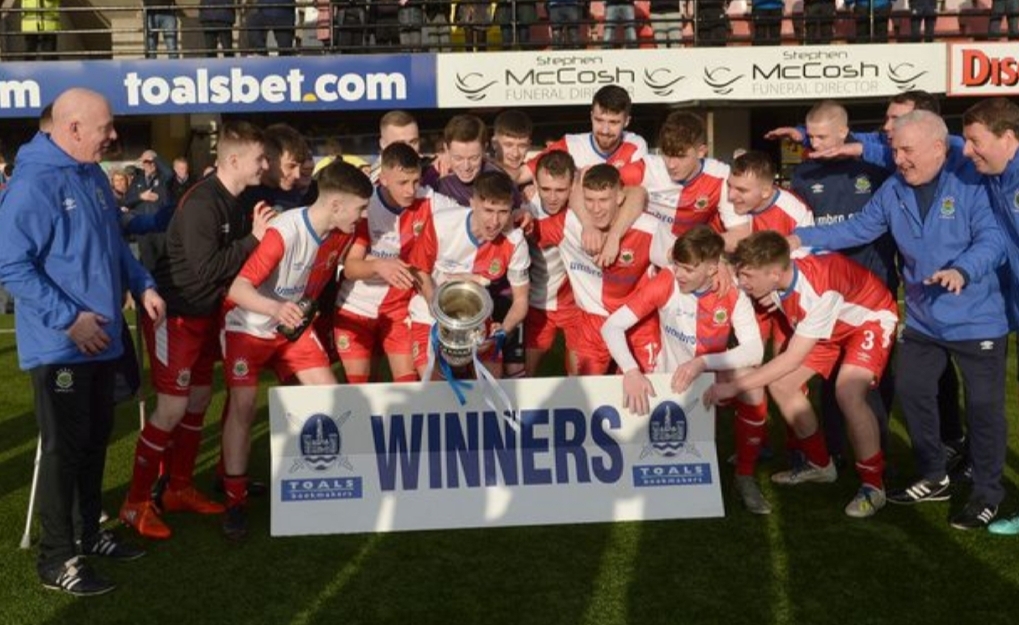
Swifts coach David Dorrian admitted with the attack-minded Marshall, who scored in their semifinal success over a now-third-tier Distillery, “I’ll be amazed if we still have him next year.” A recent trainee at West Ham, there is apparent interest in his services, in common with a side that for being so young is so very, very good.
“The club does take it seriously, the manager (Northern Ireland men’s record goalscorer David Healy, a four-time title winner helming the senior Blues side) does like to see us doing well in it,” he explained as written in Belfast Live.
“It’s strange because we never have the same group of players two years in a row, every year I get a different group,” he added, such is the sustained talent production like flowing in the club.
Meanwhile, Newington, local to the area and who share nearby Solitude with Cliftonville, came out on top of an eight-goal extra-time thriller against Bangor. Two contenders in the third-tier, it was an ex-Bangor striker in Dáire Rooney who made his mark off the bench to put seal on a 5-3 win under the Seaview floodlights, a ding-dong battle where Ryan Arthur’s brace helped completely overturn an initial 2-0 lead for the ‘Ton but alas it was not to be for the boys in yellow.
“We really want to win it again, it would mean a hell of a lot to me personally, especially having lost it already,” expressed Newington captain Richard Gowdy, a respected senior squad member and feature both in the 2017 and 2019 editions.
“We’re a young squad now, I would be one of the more experienced ones, and this club is full of good people… As much joy as it would bring to me and the players, to see how much it would mean to other people, it would mean a hell of a lot to them as well.”
It is a final that should ultimately highlight both sides of participants. Those who compete spiritedly at youth level to catch the attention of their senior side and interested parties, and those with intentions of displaying their quality in the hope that it can contribute to a continued trajectory where at the end of it, they compete as equals against the main unit of the youth side they face. All is set up on Saturday for a closely-fought and courageous affair, aided by a morning kickoff to accommodate everyone, where one team will walk away in much higher spirits than the other.
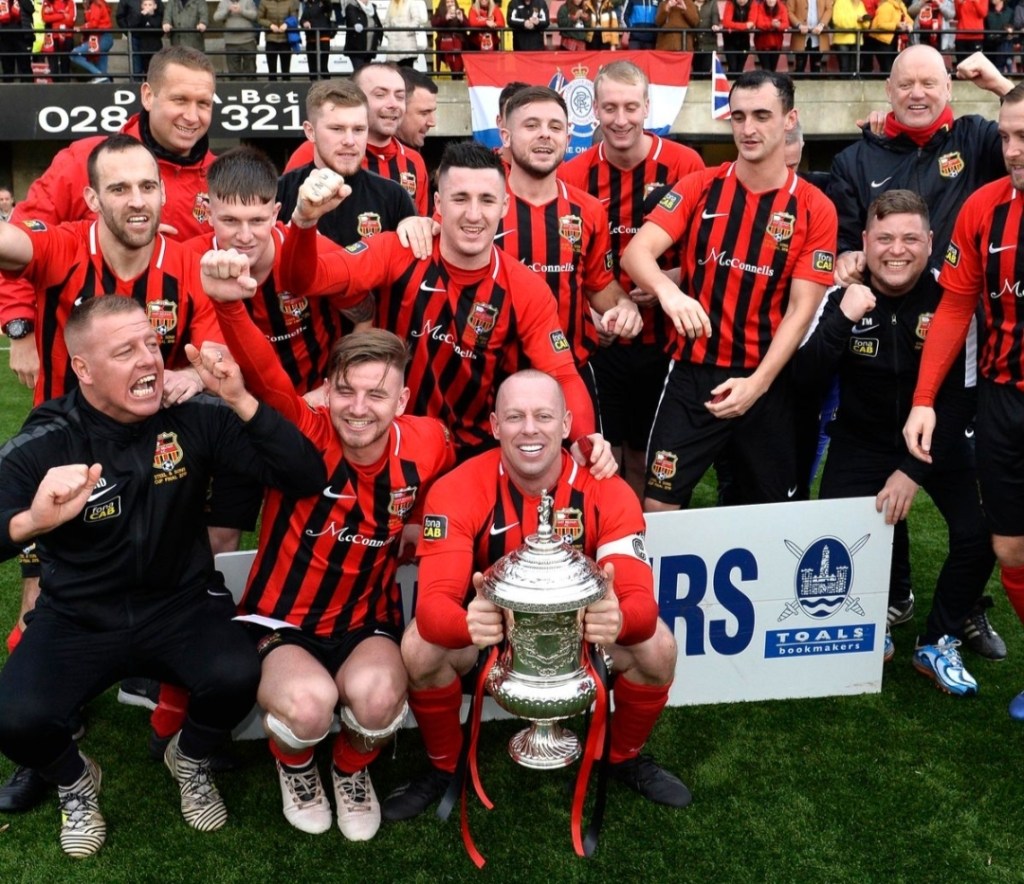
Featured image from PressEye, via itv.com (Newington’s Steel and Sons Cup win in 2017)
- It’s unfair to put blame at feet of Linfield and Cliftonville for Irish Cup Final crowd disorderA penny for the thoughts of Linfield and Cliftonville this week. This year’s Irish Cup Final was a spectacular in every sense. Nearly 15,000 packed inside Windsor Park for the biggest-attended domestic fixture in Northern Ireland this century and an occasion to… Read more: It’s unfair to put blame at feet of Linfield and Cliftonville for Irish Cup Final crowd disorder
- Irish League chiefs must improve provisions in place to attract younger fans and familiesLet’s get a basic fact of life out of the way first – no one likes a price hike. No one likes a price hike in the same way that no one likes paying taxes, bills, debts, insurance and other such necessary… Read more: Irish League chiefs must improve provisions in place to attract younger fans and families
- How the Irish FA’s new ‘Conference Layer’ for intermediate football can be big hit or own goalChanges to the intermediate football sphere in Northern Ireland have long been touted and, going by the Irish FA’s latest update on the topic, closer than ever to coming to fruition. From the 2026-27 campaign, a new ‘Conference Layer’ will be in… Read more: How the Irish FA’s new ‘Conference Layer’ for intermediate football can be big hit or own goal
- Steven McCullough’s crucial goal in relegation play-off seals him as a Ballymena United greatThere’s been a change in priorities for Ballymena United during recent years – albeit not necessarily the type supporters would’ve perhaps wanted. In 2019, the Braidmen were the second best team in the Irish League. Runners-up behind Linfield that year, and just… Read more: Steven McCullough’s crucial goal in relegation play-off seals him as a Ballymena United great
- Ending Cliftonville’s Irish Cup drought proves Jim can fix it… now he must target league gloryFinally, it’s Cliftonville’s year in the Irish Cup. An agonising waiting game ends at last and a drought that lasted 45 painful years is over in one burst of champagne rain. Since 1979, the Reds have contrived to fail in various ways… Read more: Ending Cliftonville’s Irish Cup drought proves Jim can fix it… now he must target league glory

 Football Chatters
Leave a comment