
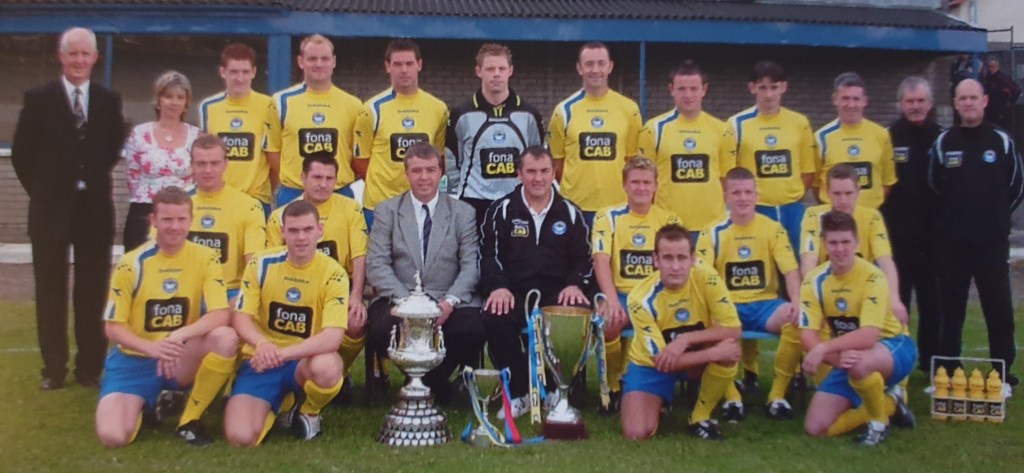
Bangor Football Club will partake in the Steel and Sons Cup final this weekend, with a Saturday Christmas Eve spectacle posing the prospect of securing a seventh iteration of the trophy to be placed in the cabinet. It would be the fourth time that the senior side has done it, dating back to the club’s first almost a century ago, and filling Christmas Day with a festive cheer and delight to revel in.
With that, it is worth reflecting on how the previous half-dozen victories played out. Storylines abound here, including how the current manager ended up on the losing end of one, how snowfall infamously put pains for a handful of days to another, as well as a wartime hero using the competition to seal his spot in the Seasiders record books.
1923 – Bangor 2-0 Woodburn (first replay)
Bangor’s first piece of Steel and Sons joy was secured 99 years ago this month. It took a second outing to determine proceedings, with the first fixture at Glentoran’s The Oval ending even-termed at 1-1, but on the replay, the joy fell Bangor’s way.
It was the second successive showpiece that the club, by this point merely five years old, had reached in consecutive years. A third-replay defeat to Crusaders in 1922, a century ago, set the backdrop for this edition.
Almost 10,000 spectators turned up to the historic venue for the first bout in east Belfast, with a gate of over £600 secured as Woodburn’s Curran delivered a leveller seven minutes from the end of the match. In an era pre-dating extra time and penalty shootouts, the all-too-natural solution of that period was simply to take things to a second match.
Brett had put the Seasiders – wearing amber and black, given both teams usually donned blue home strips – ahead just before the hour in the initial clash, and Bangor again seized advantage in the replay through Mahood.
But the second goal stands as one of the strangest that the club has scored in their history.
In the 83rd minute of the match, the ball was kicked out of play for a Bangor corner – or at least it should have been, because the referee had never actually seen the ball cross the line. Rather, the man in the middle, going by Mr T. Liggett, ruled that it was still in play, and unbeknownst to the Woodburn shot-stopper who was in fact preparing for a goal kick, Bingham nicked it and tapped into an untended net for a legal goal. Were it to be seen in this day and age, it would be deemed a conspiracy!
Nevertheless, however they come, it put seal on a 2-0 victory and crowned Bangor as Steel champions for the first time.
1940 – Bangor Reserves 2-1 Distillery II
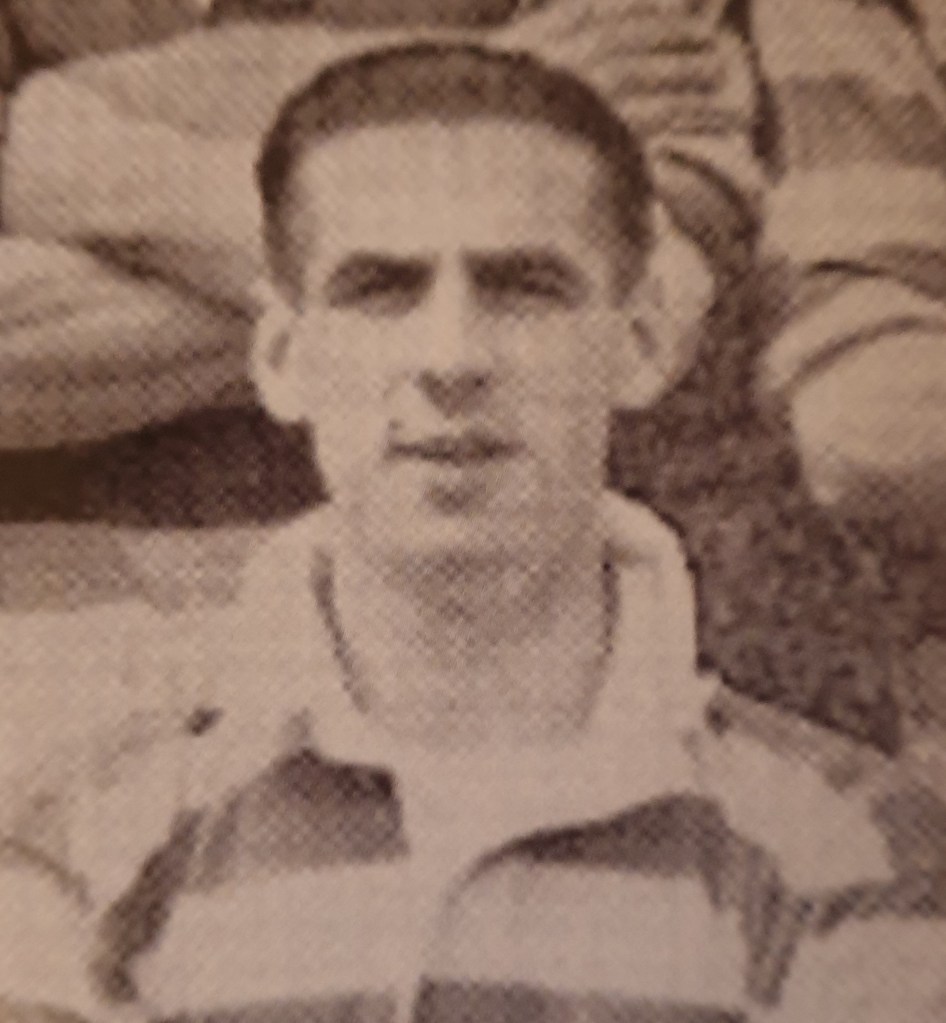
This was a ‘Bangor Reserves’ final victory, but one in all but name. The 1940/41 campaign – apart from in the Irish Cup – was played under that title, due to the Seasiders losing their senior status before the crusade started.
In any case, it was still a successful one, and it was capped with more Steel and Sons glory.
Previous victories over Monkstown, Sirocco Works, Larne and St Mary’s set up a showdown with Distillery’s Reserves at Solitude, the home of Cliftonville, in north Belfast. Armed with a 74-goal striker supremo in Billy Bradford up top, a striker who makes Adam Neale’s impeccable form seem paltry by comparison, a 2-1 win was the end product.
The early-season saw Bangor required to play home fixtures in Newtownards, given that Clandeboye Park had been requisitioned by the Army. After all, a second World War was only declared a year ago, hence football served as a respite during turbulent times across the globe.
The campaign was a strong one for the Seagulls, securing 23 wins from a possible 26 in the Intermediate League. It was Belfast Celtic’s Seconds who ultimately prevailed, however, as they attained more than the Yellows’ 47 points in a two-point era. Still, it at least marked some silverware to take pride in.
1944 – Bangor Reserves 3-0 Larne Olympic
Preceding Bangor’s most recent appearance in the final – excluding this year’s, of course – was a meet of the respective ‘second’ sides of the Seasiders and Larne towards the end of wartime.
It was no surprise again to see Bradford make his mark on it. It also capped off the difficult time of competing in the Intermediate League while several parts of the footballing sphere across the island of Ireland had been suspended.
Amid that tenure, there was this 3-0 victory in a meet of two major players at the intermediate level, combined with Intermediate Cup success in what was an assured three-peat for Bangor. While missing out on the title, a cup double hardly gives cause for complaint, and a run of nine trophies in seven years between 1940 and 1947 surely marks as one of the most laden spells in which new pieces of silverware entered the cabinet.
1994 – Bangor Reserves 1-0 Linfield Swifts
On this occasion, with Bangor’s senior side right in the midst of their golden era fighting by the top-tier summit, it was the Reserves to do the job.
Now, the novelty around this victory comes from the fact that a certain Lee Feeney was on the losing side on that day.
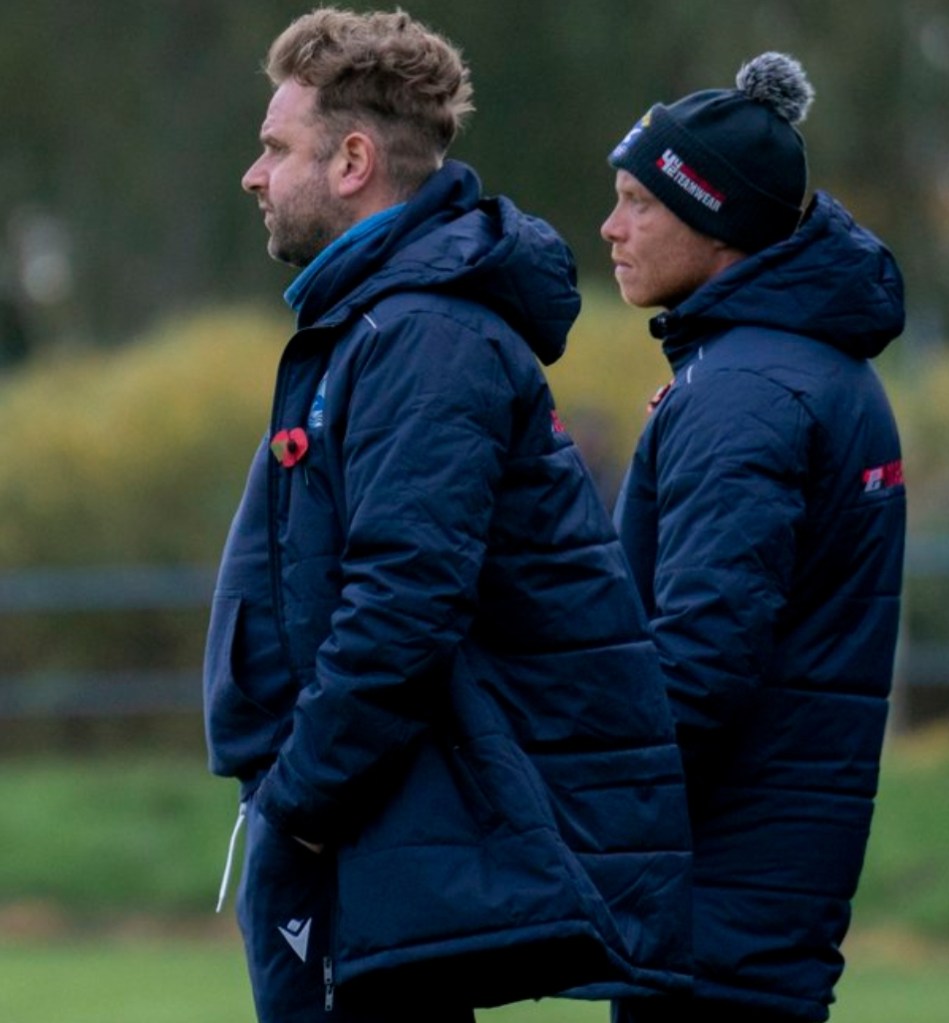
The Kilkeel hero will, of course, be in the Seasiders’ dugout on Christmas Eve with hopes of guiding the team to glory.
It was a stated intention of Feeney, who was just 16 when his Blues Swifts were beaten at Seaview, that he wanted to win the Steel and Sons Cup with the Seagulls when they hired him two-and-a-half years ago.
Aged 44 now, the Clandeboye chief – who also enjoyed a brief playing stint between 2005 and 2006 with the Seasiders – referenced this loss when interviewed by Michael McNamee on BBC Radio Ulster last weekend. It is no secret that this is a cup Feeney has had his eyes on for a long time, and 28 years on from seeing that feel of success slip through his fingers, he will hope to embrace the revelry of victory this time around.
2004 – Bangor 2-0 Glentoran II
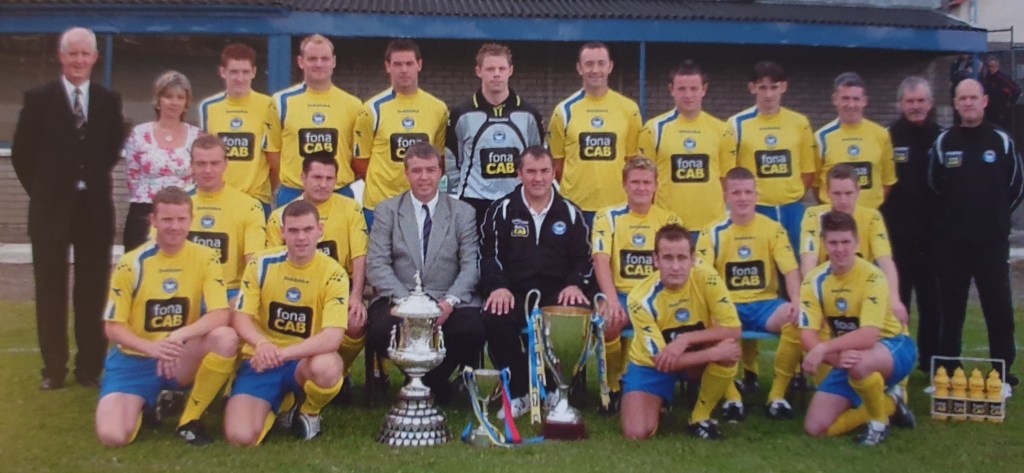
The tale of the Seasiders’ success in the competition in 2004 was typically unusual. No less that on the most recent occasion the club actually were scheduled to contest the decider on Christmas Day, the big man in the red suit wasn’t for tempering the adverse conditions.
Facing a Glens side that ironically included Jamie Mulgrew – a midfielder who only just made his 700th appearance for the east Belfast institution’s bitterest rivals Linfield last week – the first date was cut to a halt before the planned finish thanks to the weather.
Heavy snowfall in north Belfast caused the match to be abandoned with 68 minutes gone. After last weekend, the supporters know how that feels.
Hence it was actually on the 29th December, the following Wednesday, that the final outcome was determined. Alongside Mulgrew, the Yellows’ incumbent Head of Mini Soccer and still a relative regular around Clandeboye Park when not in action with the Blues, were Ian Mannus – the younger brother of former Linfield shot-stopper, multiple Premiership champion, Northern Ireland international and 2022 League of Ireland title-winner Alan – and another familiar face to Bangor fans in attacker Billy Youle.
Michael Halliday was part of the first-team fold, of course. Irish and Gibson Cups were more in his sights rather than Steels.
A lot of quality in the record champions’ ranks, but Eric Halliday’s yellow and blue soldiers were not to be deterred.
Andy Morrow set the Seasiders in an advantageous position just before half time, with the club legend’s strike followed up by Marty Verner’s stunning 30-yard free kick in the second period. A two-goal win and a clean sheet ensured the prize was headed back to Clandeboye.
George Bowden’s young side were not able to conjure up a response. 18 years on, Bangor bested a new generation of Glens youngsters in the last-16 stage en route to securing their spot in this year’s iteration.
Could that be a positive omen come kick-off?
2011 – Bangor 2-1 Larne
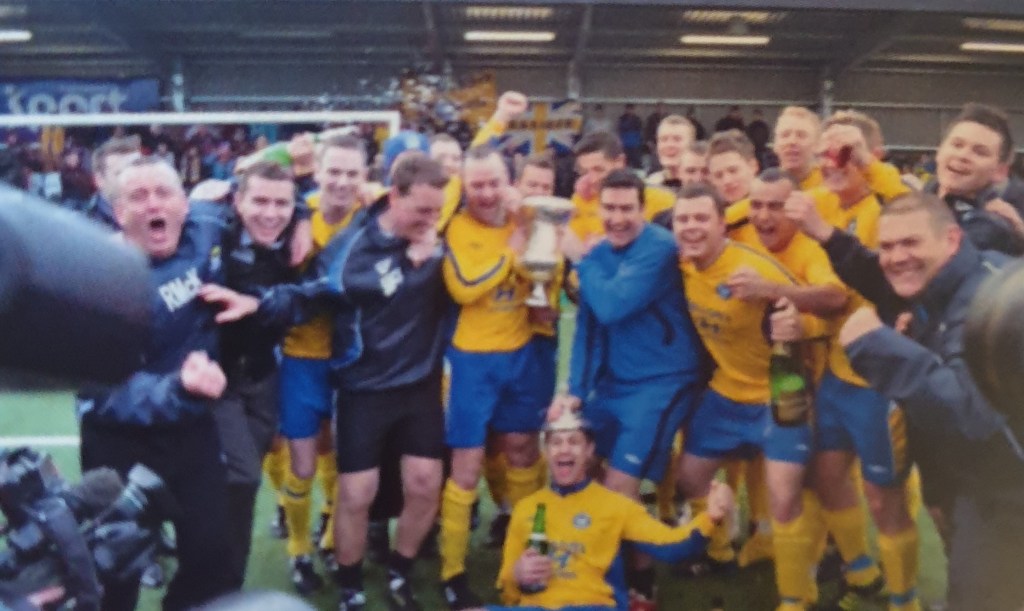
In Bangor’s most recent triumph 11 years ago, it was a battle of two clubs by the Northern Irish east coast.
While not on the same terms now as then, with high-flying Larne atop the Premiership and harbouring serious hopes of securing their first-ever top-tier title, in those days this promised to be a closely-contested affair that could have gone either way.
The Inver Reds and the Seasiders have history stretching back as two clubs with decorated histories at the intermediate level. Between two well-supported clubs, a 3,000-capacity crowd flocked down in the hope that their side would edge out on top of what was now an artificial Seaview surface.
The red-shirted team from Inver Park were in double-digits for victories in the tournament, but had not held the cup aloft since winning it four times straight between 1968 and 1971. They held grand aspirations of attaining their 12th type of this trophy 40 years on from their last one, and could back their chances.
But two goals within 10 first-half minutes put the Yellows in the driving seat. A 27th-minute deadlock-breaker by Gareth McLaughlin put Frankie Wilson’s boys ahead before future manager Garth Scates doubled the lead eight minutes from the end of the opening period.
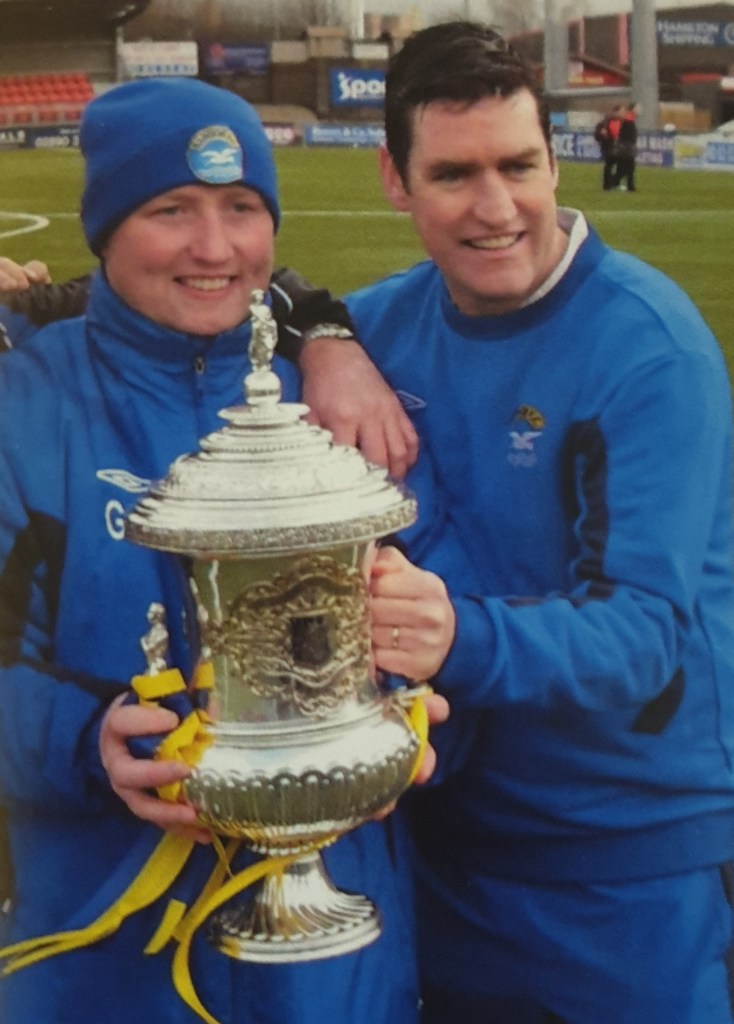
Wilson – a former player of both clubs, and who sadly passed away a couple of months ago – now had to adjust so Bangor held their advantage.
And despite Paul Millar’s troops pulling one back in the second half through a Marc Brown penalty on 73 minutes, they could not close it completely and force further nerves via the cruelty of extra time. While much has changed in terms of expectations around Larne these days, a half-century since taking this honour is a long time which, although not for any negative reason, is set to get longer.
The scoreline finished 2-1 on Christmas Eve, and Wilson cemented his legacy by achieving his first major honour as a manager with Bangor.
“The atmosphere was absolutely unbelievable and it’s as good a crowd as Crusaders will see at Seaview,” the boss stated in the aftermath.
With the outfit’s next showpiece coming on the day before Christmas too, they will aspire for a similar end product set amid a tinge of poignancy around the fact that Wilson is no longer with us.
This Saturday against Dunmurry Rec presents a chance to generate some new stories, some new history. Time will tell whether that happens or not, whether for better or worse, but a sound record in the final battle during previous appearances bodes well for a group whose motivation to set records straight is through the roof right now.
Now that you’ve read this piece on Bangor’s successful outings in the Steel and Sons Cup final, you know what to do.
Over 1,200 tickets sold already. We want that number to increase even more. £7 for adults and £5 for concessions if you fancy.
Featured image from Bangor Centenary Book (2019).
- It’s unfair to put blame at feet of Linfield and Cliftonville for Irish Cup Final crowd disorder
 A penny for the thoughts of Linfield and Cliftonville this week. This year’s Irish Cup Final was a spectacular in every sense. Nearly 15,000 packed inside Windsor Park for the biggest-attended domestic fixture in Northern Ireland this century and an occasion to savour that, for the most part, featured backing from both sides that supported… Read more: It’s unfair to put blame at feet of Linfield and Cliftonville for Irish Cup Final crowd disorder
 - Irish League chiefs must improve provisions in place to attract younger fans and families
 Let’s get a basic fact of life out of the way first – no one likes a price hike. No one likes a price hike in the same way that no one likes paying taxes, bills, debts, insurance and other such necessary expenses which, in themselves, are rising amid a general rise in the cost… Read more: Irish League chiefs must improve provisions in place to attract younger fans and families
 - How the Irish FA’s new ‘Conference Layer’ for intermediate football can be big hit or own goal
 Changes to the intermediate football sphere in Northern Ireland have long been touted and, going by the Irish FA’s latest update on the topic, closer than ever to coming to fruition. From the 2026-27 campaign, a new ‘Conference Layer’ will be in effect as part of a radical shake-up of the intermediate levels of the… Read more: How the Irish FA’s new ‘Conference Layer’ for intermediate football can be big hit or own goal
 - Steven McCullough’s crucial goal in relegation play-off seals him as a Ballymena United great
 There’s been a change in priorities for Ballymena United during recent years – albeit not necessarily the type supporters would’ve perhaps wanted. In 2019, the Braidmen were the second best team in the Irish League. Runners-up behind Linfield that year, and just seven points adrift of top spot, the peak years of David Jeffrey’s tenure… Read more: Steven McCullough’s crucial goal in relegation play-off seals him as a Ballymena United great
 - Ending Cliftonville’s Irish Cup drought proves Jim can fix it… now he must target league glory
 Finally, it’s Cliftonville’s year in the Irish Cup. An agonising waiting game ends at last and a drought that lasted 45 painful years is over in one burst of champagne rain. Since 1979, the Reds have contrived to fail in various ways in their pursuit of that elusive ninth Irish Cup – until a man… Read more: Ending Cliftonville’s Irish Cup drought proves Jim can fix it… now he must target league glory
Make a one-time donation
Make a monthly donation
Make a yearly donation
Choose an amount
Or enter a custom amount
Your contribution is appreciated.
Your contribution is appreciated.
Your contribution is appreciated.
DonateDonate monthlyDonate yearly
 Football Chatters
Leave a reply to Steel and Sons Cup final preview: A chance to cement a place in history for Bangor – Football Chatters Cancel reply